Onions are among the most widely used ingredients in the food industry. From spice blends and savoury snacks to sauces, soups and ready-to-eat meals, they contribute an important flavour profile to countless food products.
Traditionally, food manufacturers have relied on fresh onions for their production requirements. However, as food processing becomes increasingly organised and production volumes grow, manufacturers also use another established option: dehydrated onions.
Available in formats such as onion powder, onion flakes and onion granules, dehydrated onion ingredients offer a practical alternative for applications where storage, handling, preparation and formulation consistency matter.
But what makes dehydrated onion useful for commercial food production? And can it really replace fresh onion? The answer depends on the finished product, its manufacturing process and the characteristics required from the ingredient.
1. Understanding fresh and dehydrated onions
Fresh onions contain a considerable amount of natural moisture. They generally need to be cleaned, peeled, trimmed and processed before being used in large-scale food production.
Dehydrated onions undergo a controlled drying process that removes most of this moisture while retaining characteristic onion flavour. The finished ingredient can then be supplied in different formats depending on the intended application.
Research published by scientists associated with ICAR-CIPHET describes conventional onion dehydration as reducing initial moisture content of approximately 86% to around 7% or less. These figures describe a typical dehydration process, not a universal specification for every commercial product.
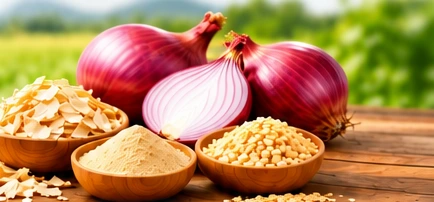
Finely ground for seasonings, spice mixes and sauces.
Dried onion pieces for visible texture.
Coarser particles for targeted applications.
This reduction in moisture makes dehydrated onions easier to store and handle than fresh onions, provided they are properly processed, packed and stored.
Fresh onions and dehydrated onions serve complementary purposes in the food processing industry. The intended application determines the right format.
2. Why do food manufacturers choose dehydrated onions?
The choice of dehydrated onion for food manufacturers is not simply about replacing fresh produce. It is often about making ingredient procurement and production more manageable. Here are five important considerations.
A. Longer storage potential and easier inventory management
Fresh onions are perishable agricultural produce. Their storage conditions, handling requirements and usable quality can change over time.
Dehydrated onions contain substantially less moisture, making them more suitable for extended storage under appropriate conditions.
For food manufacturers, this can help with:
- Maintaining ingredient inventory for planned production.
- Reducing dependence on frequent fresh-onion procurement.
- Managing seasonal sourcing requirements.
- Simplifying warehouse handling.
However, dehydrated onions are sensitive to moisture absorption. Suitable moisture-barrier packaging and proper storage conditions remain essential to protect their quality.
B. Reduced preparation and processing work
Fresh onions require several preparation activities before entering a production process. Depending on the operation, these may include washing, peeling, trimming, chopping, slicing and cooking.
Dehydrated onion products are already processed into usable formats. This can eliminate or reduce several preparation steps at the manufacturing facility.
For businesses producing seasoning blends, packaged snacks, spice mixes and instant food products, this makes ingredient handling more straightforward.
C. More convenient transportation and storage
A large proportion of fresh onion weight comes from water. Removing much of this moisture allows manufacturers to handle a more concentrated ingredient instead of transporting and storing the equivalent fresh produce with its original water content.
This can offer advantages in warehouse space planning, ingredient transportation, bulk procurement, handling and internal movement.
The actual logistics benefit depends on product format, packaging, transport conditions and the quantity required in the final formulation.
Fresh and dehydrated onions should not be compared only on their purchase price per kilogram. Buyers should also consider usable yield, preparation labour, handling losses, storage costs and the quantity required to achieve the desired flavour in the finished product.
D. Better control over ingredient specifications
In commercial food production, using ingredients that meet defined specifications is important. Manufacturers may require particular characteristics such as moisture content, particle or mesh size, colour and aroma, pungency and flavour profile, foreign-matter limits and microbiological quality.
Dehydrated onion powder, flakes and granules can be procured against defined specifications, making them useful for standardised manufacturing processes.
However, consistency is not automatic. It depends on raw-material quality, dehydration practices, grading, storage and supplier quality controls.
E. Multiple applications across the food industry
One of the advantages of dehydrated onion is its versatility. Different formats can be selected according to the requirements of individual food products.
- Seasoning manufacturers and spice manufacturers can use onion powder in dry blends.
- Snack manufacturers can incorporate onion powder into flavouring and seasoning systems.
- Sauce and soup manufacturers can use powder, flakes or granules depending on formulation.
- Ready-to-eat food manufacturers can use dried onion ingredients in selected premixes and recipes.
The right format depends on the desired flavour, texture, particle size and processing method.
Fine powder distributes more evenly in dry seasonings and spice formulations.
Flakes may suit applications where visible onion pieces are desirable in the final food.
3. Fresh onion vs dehydrated onion: a practical comparison
For procurement teams, the differences are easiest to assess against the requirements of the finished product.
| Parameter | Fresh onion | Dehydrated onion |
|---|---|---|
| Moisture | Naturally high | Substantially reduced |
| Preparation | Requires cleaning and cutting | Available in ready-to-use formats |
| Storage | Requires suitable fresh-produce storage | Suitable for longer storage when properly packed |
| Transportation | More water weight to transport | More concentrated ingredient |
| Form | Whole, chopped or sliced | Powder, flakes or granules |
| Production handling | Additional preparation steps | Easier measurement and handling |
| Texture | Fresh vegetable texture | Depends on dried format and rehydration |
| Applications | Fresh cooking and products requiring fresh texture | Seasonings, sauces, snacks, soups and processed foods |
This comparison highlights why dehydrated onion can be a practical ingredient choice for commercial manufacturing. However, fresh and dehydrated onions do not perform identically in every recipe.
Fresh onions remain suitable for applications requiring their natural texture, moisture contribution and characteristic cooking behaviour. Dehydrated onions are particularly useful in applications that require dry ingredient blending, measured dosing or simplified preparation.
4. Choosing the right dehydrated onion format
Choosing the right format is as important as choosing between fresh and dehydrated onions.
Dehydrated onion powder
Onion powder is a finely ground format that can be incorporated into dry ingredient blends and formulations where relatively uniform distribution is required.
Common applications include spice and masala blends, snack seasonings, instant food mixes, soup and sauce formulations, and savoury flavouring blends.
Dehydrated onion flakes
Onion flakes retain a recognisable dried onion-piece format and can be used where visible pieces or texture are desired. Common applications include soups and premixes, ready-to-cook food products, savoury mixes and selected snack formulations.
Dehydrated onion granules
Onion granules have a coarser particle size than powder and offer another option for manufacturers requiring a less finely ground ingredient. Common applications include spice blends, seasoning mixes, sauces and savoury food preparations.
A snack manufacturer developing a dry seasoning blend may prefer onion powder because its fine particle size can support more uniform mixing with other powdered ingredients.
A manufacturer developing a ready-to-cook soup containing visible vegetable pieces may instead consider onion flakes, depending on the desired texture after rehydration.
Neither format is universally superior. Selection should be based on product formulation, processing conditions, sensory requirements and the buyer's technical specifications.
5. India's dried onion exports and commercial demand
Dehydrated onions are not a new development in food processing. They have been used commercially for decades. Nevertheless, international trade data demonstrate India's significant presence in this ingredient category.
According to World Bank World Integrated Trade Solution (WITS) data, based on UN Comtrade, this represents an increase of approximately 44% in export volume between 2022 and 2025.
These figures demonstrate the scale of India's participation in the global dried onion trade. However, they should not be interpreted as the growth rate of the entire dehydrated onion market.
The trade classification covers dried onions in different forms and does not separately report individual commercial formats such as powder, flakes and granules.
For food businesses sourcing dehydrated onion ingredients, India's established agricultural supply base and export activity make it an important sourcing market.
6. What to check when buying dehydrated onion in bulk
Whether working with an onion powder supplier or a bulk dehydrated onion supplier in India, commercial manufacturers should look beyond comparing prices per kilogram.
| Buyer checkpoint | What to verify |
|---|---|
| Product specifications | Moisture, mesh size, colour, aroma and pungency. |
| Batch consistency | Comparable performance across regular deliveries; samples and documented acceptance criteria. |
| Food safety | Applicable documentation, microbiological test results and contaminant controls. |
| Packaging | Protection from moisture, contamination and handling damage. |
| Traceability | Batch identification, technical specifications and Certificate of Analysis where applicable. |
| Supply reliability | MOQ, recurring quantities, packaging format and lead times. |
| Total procurement cost | Transport, usable yield, storage, handling and performance. |
Questions to ask a new supplier
- Can you provide an agreed specification sheet?
- Are samples representative of regular supply?
- Can moisture and particle-size limits be maintained?
- Are relevant quality and food-safety test results available?
- What are the MOQ and packaging options?
- What is the typical delivery lead time?
- How are traceability and quality complaints handled?
These questions help purchasing and quality-assurance teams evaluate supplier suitability before placing recurring bulk orders. Choosing the right onion powder supplier is essential for food manufacturers seeking consistent quality, competitive pricing and reliable bulk supply.
7. Conclusion: choosing the right onion ingredient
Fresh onions continue to play an important role in food preparation and manufacturing. However, dehydrated onions offer practical advantages where easier handling, reduced moisture, storage convenience and controlled ingredient formats are important.
For food manufacturers, the decision should depend on the intended application, product specifications, production process and overall procurement requirements.
Whether you need onion powder for seasoning blends or are evaluating other dehydrated onion formats for commercial formulations, choosing the right ingredient and a dependable supply partner makes a difference.
At FarmVero, we focus on sourcing and supplying dehydrated food ingredients for businesses and food manufacturers. Explore our dehydrated ingredient range, read about onion drying temperature, or contact FarmVero to discuss your bulk onion ingredient requirements, specifications and sourcing needs.
FarmVero — FRESH. PURE. FINE.