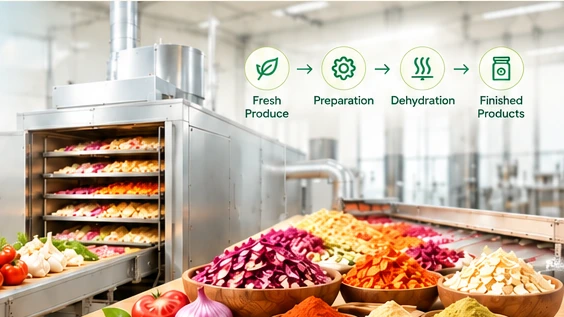
When we think about dehydrated onions, moisture removal is usually the first thing that comes to mind. However, producing a good-quality dehydrated ingredient involves much more than simply removing water.
One important factor in the onion dehydration process is drying temperature. It can influence the final ingredient's pungency, colour, aroma and overall sensory characteristics. For food manufacturers, these factors directly affect the taste, appearance and consistency of the finished product.
Does higher heat always mean poorer onion quality? How can buyers assess onion flavour retention when selecting dehydrated onion powder or dehydrated onion flakes?
1. Why is onion drying temperature important?
Fresh onions typically contain around 82–87% moisture. During controlled dehydration, much of this water is removed to create an ingredient with considerably lower moisture content. Hot-air drying is an established processing method, but temperature influences more than the speed of moisture removal.
Influences heat exposure and flavour changes
Determines how long onions remain exposed
Affect moisture removal and uniformity
If conditions are not adequately controlled, onion powder and flakes can show changes in pungency, characteristic aroma, colour, rehydration properties and overall sensory quality.
2. How does drying affect onion pungency?
Onion pungency comes from naturally occurring sulphur-containing compounds. When an onion is sliced, the enzyme alliinase interacts with flavour precursors and creates compounds associated with the characteristic flavour and pungency of onion.
Scientists often measure enzymatically produced pyruvic acid as an indicator of onion pungency. Heat and drying conditions may change this measurement and the resulting flavour profile.
A study of onion shreds found that increasing hot-air drying temperature from 50°C to 65°C was associated with lower pyruvic acid levels under the tested conditions. The result helps explain why two dehydrated onion powders can have similar appearance but different flavour intensity.
3. How does temperature influence onion flavour retention?
Onion flavour is not created by a single chemical compound. It is a combination of volatile sulphur compounds and other aroma components, some of which can be lost or transformed during drying.
A 2017 Food Chemistry study compared onion powders dried at 50°C, 70°C and 90°C. The researchers observed changes in volatile composition: some fresh-onion-associated compounds decreased, while higher temperatures encouraged formation of different aroma notes.
The study reported reductions in dipropyl disulphide during drying, formation of thiophenes associated with caramel-like and sweet notes at higher temperatures, and higher retention of certain aldehydes in lower-temperature samples. These findings apply to the experimental conditions, rather than every commercial drying process.
Under those experimental conditions, lower-temperature drying retained certain fresh-onion aroma characteristics better. Yet the most suitable flavour profile depends on the buyer's product—from mild soup bases to stronger savoury seasonings.
Lower temperatures may preserve certain volatile compounds under some processing conditions.
Higher heat can alter aroma and produce different sensory notes—neither inherently right nor wrong.
4. Why can dehydrated onion become darker?
Colour is an important finished-product quality parameter. Excessive or prolonged heat exposure can contribute to browning, including changes associated with the Maillard reaction between reducing sugars and amino compounds.
Research on onion shreds found greater colour change as hot-air drying temperature increased from 50°C to 65°C in that experiment. Differences may also depend on onion variety, preparation, drying time and moisture level.
A darker powder is not automatically unsuitable; buyers should evaluate colour against an agreed specification and the intended finished-food application.
5. What does the scientific research show?
Published research demonstrates that the onion drying process can change pungency indicators, colour and aroma. These findings are informative, but should not be mistaken for universal production specifications.
Impact of pretreatment and drying methods on onion shreds
As temperature rose from 50°C to 65°C, reported pyruvic acid decreased from 50.77 to 43.14 µmol/g; colour difference increased from 12.04 to 17.14 under the study conditions.
Volatile composition of convectively dried onion powders
Tests at 50°C, 70°C and 90°C found that drying temperature affected the volatile composition and sensory characteristics of onion powder.
Reducing drying time through process design
Research on partial mechanical dewatering before hot-air drying showed that a complete processing approach can improve drying efficiency while protecting desirable characteristics.
6. Is there one ideal temperature for onion dehydration?
No single temperature works best for every variety, drying system or product application. The optimal conditions depend on onion variety, slice thickness, airflow, humidity, drying duration and equipment.
For buyers, the most meaningful question is not simply “At what temperature was it dried?” but rather “Does the finished ingredient consistently meet our agreed specifications?”
7. What should food manufacturers check?
Commercial buyers evaluating dehydrated onion powder quality should compare representative samples and finished-product specifications. Temperature matters, but procurement decisions require a broader quality assessment.
| Quality parameter | Why it matters to buyers |
|---|---|
| Moisture | Storage suitability and moisture sensitivity |
| Colour | Appearance and consistency in the finished food |
| Pungency & aroma | Flavour intensity and formulation suitability |
| Mesh / particle size | Mixing, distribution, visible texture and rehydration |
| Microbiological quality | Compliance with the buyer's food-safety limits |
| Foreign matter & purity | Ingredient cleanliness and quality expectations |
| Packaging & traceability | Protection, batch identification and documentation |
Choosing a dehydrated onion supplier in India
When choosing a dehydrated onion supplier in India, food manufacturers should evaluate specifications and documentation rather than relying on a supplier's location alone. Before qualifying a supplier, ask for:
- Product specification sheet
- Representative samples for trials
- Moisture and particle-size limits
- Relevant test reports and COA
- Batch traceability details
- MOQ and packaging options
- Recurring supply lead times
- Quality-complaint procedure
8. Choosing ingredients for a real formulation
A snack-seasoning manufacturer may need a fine onion powder that blends uniformly with spices and delivers defined pungency. An instant-soup manufacturer may instead need dehydrated onion flakes, predictable rehydration and a distinct sensory profile.
The same ingredient may not suit both applications. Food businesses should test sample batches under their actual manufacturing conditions and evaluate sensory performance alongside documentation and price.
9. Conclusion: quality begins with the complete process
Drying temperature affects onion pungency, colour and flavour, but it should always be considered together with processing time, airflow, onion variety and dehydration technology. For bulk buyers, finished-product performance and consistency matter more than any single drying parameter.
At FarmVero, we focus on sourcing and supplying dehydrated food ingredients for commercial applications. Read our dehydrated vs fresh onion guide, explore our product range, or contact us to discuss ingredient specifications, samples and bulk requirements.
Research references
1. Sahoo et al., Impact of Pretreatment and Drying Methods on Quality Attributes of Onion Shreds (2015). Research article
2. Volatile Composition and Sensory Characteristics of Onion Powders Prepared by Convective Drying (2017). PubMed
3. ICAR-CIPHET, A Less Energy Intensive Process for Dehydrating Onion. Research article
4. Effect of Variety and Drying Temperature on Quality of Dried Onion Powder (2018). PubMed